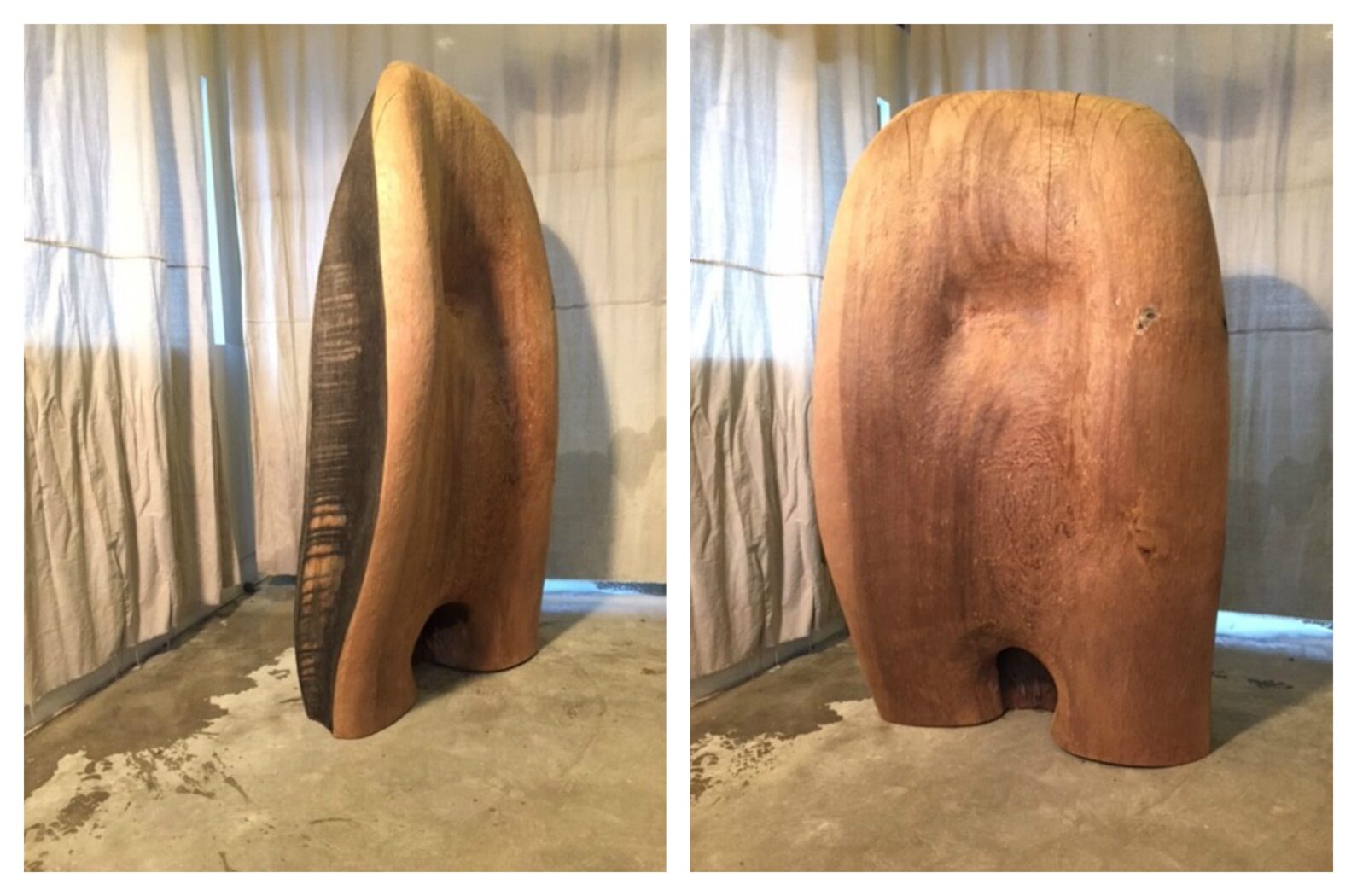
From the wilderness of southern Alaska to the austere Kyoto Gardens, sculptor Jerry Wingren has always seen life within empty spaces, and he channels that vision into his stone sculptures.
Born and raised in the small Alaskan port town of Ketchikan, Wingren began his academic career studying Scandinavian and Germanic languages and literature at the University of Washington in 1959, and later earned a Fulbright scholarship for German drama studies with the University of Bremen in Germany. While completing his dissertation in the mid-seventies, he met two men who would ultimately change his life’s trajectory: master sculptors Otto Almstadt and Moritz Bohrmann, with whom he began an apprenticeship in stone sculpture.
Working with the master sculptors sparked a passion for art that Wingren did not yet know he had. He eventually withdrew from academia to stay in Germany two additional years to participate with Almstadt’s and Bohrmann’s art group, Kontakt Kunst, creating sculpture on-site in action events throughout the country.
“While they were teaching me the techniques of stonework, they were also teaching me to see,” Wingren said. “The revelation of my apprenticeship was that stone is not a dead material.”
While mastering sculpting stone, Wingren also immersed himself in origami. His interest in the art of folding paper inspired his first series in 1988, “Cut and Fold,” which involved cutting large steel and aluminum into three-dimensional golden rectangles, playing with shadows among the structures.
From 1968 to 1974, Wingren returned to the U.S. and settled in Boulder to teach languages and literature at the University of Colorado. His career took another turn in 1994, when he took a sabbatical to Japan. Eager to expose his art to fresh light and new ideas, Wingren became captivated by the Kyoto gardens and the juxtaposition they presented between emptiness and presence. He then learned of 間 [ma], the Japanese character translated as “pause” or “gap”—known in the West as “negative space.” Through his sculptures, he began exploring this empty space between objects, which he posits is as much a part of the art as the stone itself.
Over Wingren’s four-decade sculpting career, he has worked in bronze, aluminum, marble, granite, steatite, cedar wood, and steel. He credits eight series as exemplary of his career’s maturation: “Cut & Fold”, “Sunshaft Stones”, “Windows”, “Standing Stones”, “Resting Stones”, “Interiors”, “Standing Interiors”, “Perspective”, and, most recently, “Voids.”
Wingren’s work continues to incorporate elements of his northwest and Scandinavian heritage with Japanese aesthetic. You can see Wingren’s work in exhibitions throughout private galleries in the U.S. and Europe, including the Denver Art Museum, the Atlanta Botanical Garden, and Berlin’s Kleine Orangerie. His works may also be found in private and public collections in the U.S., Germany, Norway, Sweden, Italy, Spain, and Japan. He continues sculpting at his studio in Boulder, Colorado. He will showcase his latest work at an Open House on Saturday, May 14, 2016.
Open House: Saturday, May 14, 10 am-7 pm
The Open House will feature 2015’s “Voids” series, eight pieces that explore the concept of open space. To create these sculptures (pictured above), Wingren carves vistas into black stone and waxes the interior planes, absorbing light as it reflects it. Wingren and his assistants will likely be working on new ones during open house, so you can see the work in action.
Directions to Wingren Studios: Take Canyon Boulevard to Four Mile Canyon. (Approximately 1 mile from Boulder). Turn right into Four Mile Canyon. After 4 miles, turn left on Logan Mill Road and follow the white triangle signs.